Transform Your Chelsea Business with AI
Chelsea business automation for food distribution, logistics, healthcare, and retail firms near the Produce Center and Chelsea Creek in Massachusetts.
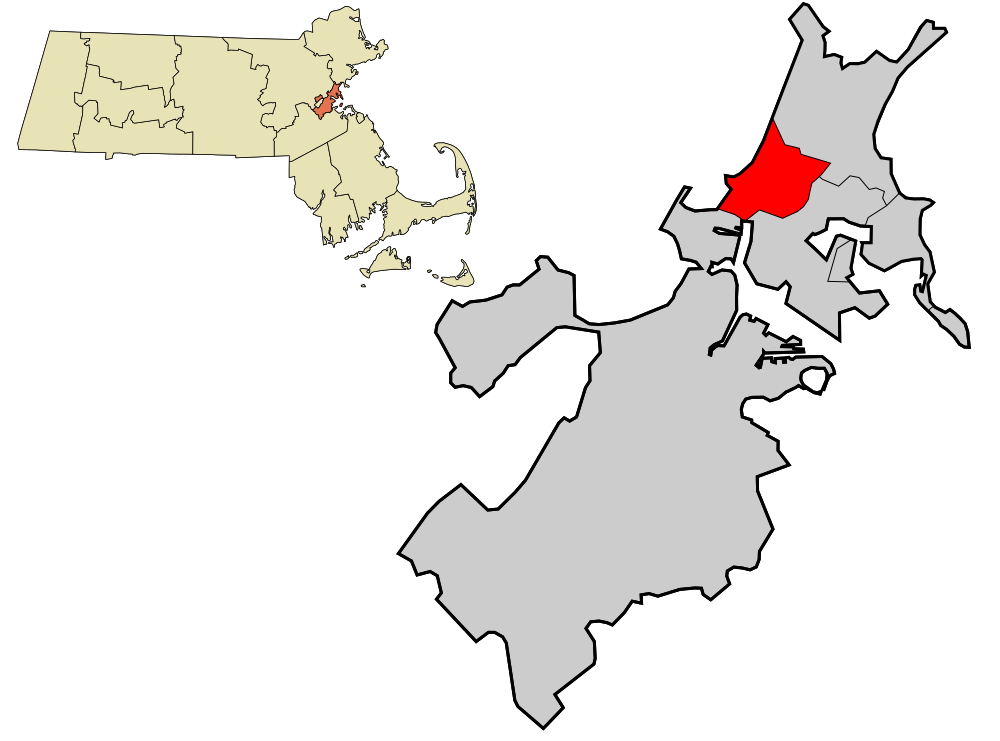
Chelsea at a glance
Chelsea is home to 40,245 residents in Suffolk County, Massachusetts, a steady local market. Local businesses here run on the same operations HummingAgent automates: answering every call, qualifying leads, scheduling, and keeping records straight.
Chelsea AI Automation Use Cases
HummingAgent helps Chelsea businesses identify repetitive workflows that can be improved with Private GPT, AI receptionist systems, agentic workflows, and intelligent automation built around real operations.
Serving Chelsea's Diverse Business Community
From cutting-edge technology to diverse industries, Chelsea businesses face unique challenges that demand innovative automation solutions.
AI Automation Services for Chelsea Businesses
Comprehensive automation solutions tailored for Massachusetts businesses
Customer Support Automation
24/7 AI voice agents and chatbots that handle customer inquiries, schedule appointments, and qualify leads for Chelsea businesses.
Learn moreBusiness Process Automation
Streamline workflows, automate repetitive tasks, and connect your Chelsea business systems for maximum efficiency.
Learn morePrivate ChatGPT
Secure, enterprise-grade AI assistants trained on your Chelsea company's data. Keep sensitive information private.
Learn moreEnterprise AI Solutions
Custom AI implementations for larger Massachusetts organizations with complex requirements and multiple departments.
Learn moreAI Workflow Automation
End-to-end workflow automation that connects your tools and eliminates manual processes for Chelsea teams.
Learn moreAI Web Creations
AI-powered websites and landing pages that convert visitors into customers for Chelsea businesses.
Learn moreIndustry-Specific AI Solutions
Specialized automation for Chelsea's key industries
AI for Law Firms
Automate client intake, document review, and legal research for Chelsea attorneys.
Explore legal solutionsAI for Healthcare
Secure automation for Chelsea medical practices and healthcare providers.
Explore healthcare solutionsAI for Real Estate
Lead qualification, property inquiries, and showing scheduling for Chelsea agents.
Explore real estate solutionsHow We Deploy AI for Chelsea Businesses
A proven 4-step process that takes you from first conversation to working automation — usually in weeks, not months.
1. Discovery & Audit
We map your workflows and pinpoint the highest-ROI automation opportunities — no guesswork, no generic templates.
2. Custom Build
We build AI agents trained on your business and your data, designed around how you actually operate.
3. Integrate & Test
We connect to the tools you already use and test against real-world scenarios before anything goes live.
4. Launch & Optimize
We deploy, monitor, and continuously improve — with 24/7 support so your automation keeps getting better.
Proven Results for Businesses Like Yours
Chelsea businesses want to see the work before booking a call. Here it is — real deployments, real outcomes.
Super Park
We built "Chatty," a 24/7 AI chatbot that handles customer service across 9,085 managed parking spaces.
Read the case studyJVRC
We transformed Colorado's premier legal research firm from paper subscriptions and manual PDF searching into a fully digital AI search platform.
Read the case studyK3 Technology
We gave K3 their own private ChatGPT with memory across clients and projects — using GPT, Claude, and 30+ models while keeping their data private.
Read the case studyReviews
What clients say on Google
“Humming Agent AI has been a trustworthy and reliable partner in helping our agency, GroundFloor Media, build a secure, proprietary AI environment from the ground up. Our team uses ChatGFM daily for research, data analysis, and editing, and it's made our work noticeably sharper and more efficient. It's freed us up to spend less time on the mechanics of the work and more time on strategy and creative thinking. Highly recommend them if you're looking for a team that understands both AI and how organizations actually work.”
“Humming Agent AI was a fantastic partner in developing our proprietary and secure AI tool, ChatGFM, from the ground up. They helped us to create an AI workspace wired into our own agency context and processes, not some off-the-shelf tool. They took our input seriously and shipped something that actually fits how we work. A great partner to work with that I highly recommend.”
“Amazing Team. Always very responsive and knowledgeable. My company hired them for an ongoing large project to create an AI agent for answering phones with a new calendar and CRM system. This agent has been designed with logic for our specific company with many verticals making it a tough task and everything is working great. We have calls going directly to AI and booking appointments. This has helped us greatly close more calls especially after hours and weekends when we get most of our call / email and text traffic. Would highly recommend them to anyone, very happy customer.”
Why Chelsea Businesses Choose Humming Agent
Local Chelsea Presence
We understand Chelsea business needs. Our remote-first team scopes each implementation around your workflows, systems, and support requirements.
Planned Implementation Support
Discovery, launch planning, and support are scoped around your team's workflows, systems, and availability in Chelsea.
Massachusetts-Sized Value
We scope AI automation around your workflow volume, integrations, data readiness, and support model before recommending a build.
Quick Chelsea Stats
Explore Chelsea
A look at the business environment where teams evaluate AI automation, workflow design, and practical implementation support.
Chelsea Business Automation Overview
Chelsea, Massachusetts packs 40,977 residents into just 1.86 square miles, making it one of the most densely populated cities in New England and one of the hardest working.
Wedged between the Mystic River, the Chelsea Creek, and the Tobin Bridge approach to Boston, this city of 759 registered business establishments punches well above its geographic weight, generating roughly $647 million in annual business payroll for nearly 13,000 workers.
Chelsea's median household income sits at $72,179, a figure that masks real strain: local unemployment runs near 9.2 percent, more than double the Massachusetts statewide rate of 4.4 to 4.7 percent, and the median home sale price of $565,500 puts homeownership out of reach for many working families in a city where a majority of residents identify as Hispanic or Latino, with the largest Salvadoran community in New England calling Chelsea home.
Chelsea's economy runs on logistics and endurance. The New England Produce Center on Market Street, one of the largest privately owned wholesale terminal markets in the country, moves fresh fruit and vegetables to more than eight million people across New England every day.
A few blocks away, Chelsea Creek quietly handles a large share of the region's home heating oil, gasoline, and jet fuel through a dense cluster of petroleum terminals, making this small city a critical node in New England's energy supply chain.
Add in MGH Chelsea HealthCare Center, the Veterans Home at Chelsea, and a municipal government and school system serving a young, growing population, and you get an economy built on high transaction volume, tight margins, and round-the-clock operational demands.
That combination, dense population, low margins, immigrant-owned small businesses, and industries that never really close, makes Chelsea an unusually strong candidate for AI automation.
Produce wholesalers processing hundreds of purchase orders before dawn, trucking dispatchers coordinating fuel deliveries across the Creek, healthcare intake staff serving a multilingual population, and city departments fielding a constant stream of resident requests are all running on manual processes that were built for a smaller, slower Chelsea.
With Boston-area labor costs climbing and unemployment locally still elevated, Chelsea businesses need to do more with the staff they already have. Custom AI systems, built around how a Chelsea business actually operates rather than a generic off-the-shelf tool, are how that gap gets closed.
Industry-Specific Automation Solutions
Tailored solutions for Chelsea's key business sectors
Healthcare
Practical automation considerations for this sector
& Human Services
MGH Chelsea HealthCare Center and the Veterans Home at Chelsea, which operates residential and long-term care programs for Massachusetts veterans with roughly 1,055 associated positions, anchor a healthcare and human services sector that serves one of the state's most linguistically diverse populations, alongside community health and social service organizations such as the Chelsea Collaborative and Roca.
Specific challenges include appointment scheduling and reminder calls that must be delivered in Spanish, Portuguese, and other languages spoken across Chelsea's immigrant communities, high no-show rates tied to transportation and work-schedule conflicts among low-wage shift workers, and intake paperwork that slows access to care for patients with limited English proficiency.
Automation opportunities include multilingual AI voice agents for appointment scheduling and reminders, automated intake form pre-population from prior visit data, follow-up calls for missed appointments and prescription refills, insurance and MassHealth eligibility verification support, and after-hours triage call routing.
A community health clinic handling 150 to 200 calls a day for scheduling and reminders could hypothetically cut front-desk phone burden by 40 to 50 percent by automating routine multilingual scheduling and reminder calls, freeing clinical staff to focus on patients physically in the building rather than the phone queue.
Retail
Practical automation considerations for this sector
, Restaurants & Small Business
Broadway and the Bellingham Square commercial corridor host a dense concentration of independent, largely immigrant-owned restaurants, markets, and service businesses that form the backbone of Chelsea's street-level economy, many operating with owner-operators handling sales, scheduling, and customer service simultaneously.
Specific challenges include phone orders and reservation calls competing with in-person customer service during peak hours, appointment and service scheduling handled entirely by the owner with no dedicated front-desk staff, and limited bandwidth for marketing, follow-up, or review management on top of daily operations.
Automation opportunities include AI answering services that take orders and reservations when staff are busy with in-person customers, automated appointment booking for service businesses like salons and repair shops, customer follow-up and review-request texts after visits, inventory and supplier reorder reminders, and basic bookkeeping data capture from receipts and invoices.
A restaurant or small retail shop currently missing an estimated 15 to 20 percent of phone orders during dinner rush because staff can't reach the phone could hypothetically recapture most of that lost revenue by routing overflow calls to an AI answering system that takes and confirms orders without pulling a team member off the floor.
Chelsea Business Districts
BELLINGHAM SQUARE
Bellingham Square is Chelsea's historic civic and commercial core, rebuilt after the devastating 1908 fire and anchored today by City Hall, whose Independence Hall-style architecture overlooks a dense strip of Latin American restaurants, markets, and service businesses. The Square's food and retail businesses run on high foot traffic and phone-in orders, making automated order-taking and appointment scheduling especially valuable for the small, owner-operated shops that line the district.
BROADWAY DOWNTOWN CORRIDOR
Chelsea's Broadway corridor functions as the city's main commercial spine, connecting Bellingham Square to the produce and industrial districts to the north. Small professional service firms, insurance agencies, and retail businesses along Broadway typically operate with lean staff, making them strong candidates for automated customer intake, appointment reminders, and administrative workflow support that lets a two- or three-person office handle a larger client base without added headcount.
PRATTVILLE
Prattville, Chelsea's northwestern neighborhood bordering Revere and Everett, mixes 19th-century multifamily housing with light industrial and warehouse operations near the produce and freight corridors. Businesses here, from small manufacturers to trucking-adjacent operations, tend to need automation focused on scheduling, dispatch communication, and supplier coordination rather than customer-facing sales tools.
BOX DISTRICT
The Box District, served by MBTA bus routes and within reach of the Silver Line SL3 Bus Rapid Transit connection into Boston, is home to a growing mix of residential development and small commercial tenants. As newer businesses establish themselves in this corridor, automated appointment booking and customer communication tools help them compete with better-staffed operations elsewhere in Greater Boston without the overhead of a large front-office team.
ADMIRALS HILL
Admirals Hill, the waterfront promontory between the Mystic River and Island End River that was converted from the former Chelsea Naval Hospital into condominiums in the early 1980s, is a quieter, higher-value residential enclave. Property management companies and service providers serving Admirals Hill residents benefit from automated scheduling and communication tools that match the more polished, responsive service expectations of this part of Chelsea's housing market.
Seasonal Business Patterns
Chelsea's business calendar tracks two overlapping cycles: the produce trade's dawn-to-dusk rhythm and New England's sharp seasonal swings.
Winter brings the heaviest strain on Chelsea Creek's petroleum terminals, as home heating oil demand across the region peaks and fuel haulers run tighter schedules through snow and ice on Route 1 and the Tobin Bridge approach; dispatch and scheduling automation becomes most valuable exactly when winter weather makes manual coordination hardest.
The same cold months push call volume at MGH Chelsea HealthCare Center and city human services offices higher, as heating assistance requests, flu-season appointments, and weather-related service disruptions all spike at once.
Summer shifts pressure to the New England Produce Center, where fresh fruit and vegetable volume climbs with the growing season and overnight order desks face their highest call volume of the year. Chelsea's proximity to Logan International Airport across the water also means summer travel season indirectly affects local logistics and hospitality-adjacent businesses that support airport-area demand.
Fall brings a compliance and paperwork crunch for many small businesses as annual licensing renewals with the City of Chelsea and state filings come due, a period where automated document collection and reminder workflows reduce the scramble that independent business owners otherwise absorb personally.
Across every season, Chelsea's round-the-clock produce and fuel operations mean there is no true off-season for phone volume or scheduling complexity, which is precisely why automation delivers consistent value here rather than a seasonal bump.
A business that only staffs up during its known peak, holiday produce demand or winter heating season, still faces the other season's demands with the same lean crew, and AI-handled intake, scheduling, and follow-up smooths that gap without requiring seasonal hiring that is already difficult in a city with 9.2 percent unemployment but a genuinely tight market for reliable overnight and shift-based labor.
ROI & Cost Analysis
Massachusetts' $15.00 hourly minimum wage sets the statutory floor, but Chelsea employers competing for staff in the greater Boston labor market typically pay well above it for the roles most relevant to automation. Using a fully loaded cost formula of base wage plus 25 percent benefits plus 7.65 percent payroll tax, a baseline minimum-wage position costs an employer approximately $19.90 an hour, or about $41,390 annually at full-time hours. Realistic Chelsea-area roles run higher:
- **Customer Service** ($20/hour base): fully loaded cost of approximately $26.53/hour, or $55,190 annually per employee. - **Administrative** ($22/hour base): fully loaded cost of approximately $29.18/hour, or $60,700 annually per employee. - **Technical/Skilled Trades** ($32/hour base): fully loaded cost of approximately $42.45/hour, or $88,300 annually per employee. - **Sales/Account Management** ($25/hour base): fully loaded cost of approximately $33.16/hour, or $68,970 annually per employee.
Applying these figures across common Chelsea staffing scenarios illustrates the scale of what's at stake.
A produce wholesaler or clinic running just one customer-service-equivalent role spends roughly $55,190 a year fully loaded; a mid-size logistics or healthcare operation with five such roles spends approximately $275,950; a larger produce distributor or hospital-adjacent facility with ten roles spends around $551,900; and an operation with 25 roles, not uncommon across the Produce Center's larger tenants, spends an estimated $1,379,750 annually in fully loaded labor costs for that single job category alone.
Automating the routine, repetitive share of that work, order intake, appointment scheduling, reminder calls, and status lookups typically account for 30 to 45 percent of a customer-service or administrative role's total hours, based on task patterns observed in similar industries.
Applied to the figures above, that suggests a Chelsea business could realistically reclaim the equivalent of $16,500 to $24,800 per role annually in staff capacity, hypothetically redirected toward exception handling, sales conversations, and patient or resident care rather than repetitive call and data entry work.
These are illustrative estimates based on typical task distribution, not guaranteed outcomes for any specific business, and actual savings depend on current staffing structure and call or transaction volume.
Implementation Roadmap
Your strategic path to successful business automation in Chelsea
Market Analysis & Planning
What happens in this phase:
Pilot Program Development
What happens in this phase:
Full Deployment & Optimization
What happens in this phase:
Ready to transform your Chelsea business?
Get a scoped estimateCompliance & Regulations
Massachusetts businesses deploying AI-driven customer communication tools must operate within the Massachusetts Consumer Protection Act (Chapter 93A) and existing state data privacy expectations, including secure handling of any personal or payment information collected through automated systems.
Healthcare-adjacent businesses in Chelsea, including any operation touching patient scheduling or intake, need automation workflows that support HIPAA-compliant handling of protected health information, particularly relevant given the concentration of clinics and the Veterans Home serving Chelsea's population.
Businesses operating within Chelsea city limits should confirm their automation vendor understands local business licensing requirements administered through the City of Chelsea's Housing and Community Development office, particularly for food service and retail operations subject to health and safety inspection scheduling.
Given Chelsea's substantial Spanish-speaking and Portuguese-speaking population, automated systems serving residents directly, whether for healthcare scheduling, city services, or retail customer service, benefit from language-access planning that goes beyond simple translation, reflecting both good practice and the spirit of Massachusetts' language access expectations for public-facing services.
Logistics and energy-adjacent businesses along Chelsea Creek should also ensure any automated compliance documentation aligns with existing hazardous materials transport and environmental reporting obligations rather than replacing them.
Success Metrics & KPIs
Chelsea businesses that automate routine call and workflow volume can reasonably target measurable, illustrative improvements based on typical outcomes for similar task-automation deployments: a 30 to 50 percent reduction in missed calls during peak hours, meaningful for produce wholesalers during overnight order windows and restaurants during dinner rush; a 20 to 35 percent reduction in no-show appointment rates for healthcare and service businesses through automated multilingual reminders; and a 25 to 40 percent reduction in time spent on manual data entry and reconciliation for businesses handling high transaction volume, such as Produce Center tenants processing daily orders.
On the cost side, businesses automating one to two full-time-equivalent roles' worth of repetitive work can target the $16,500 to $24,800 per-role annual capacity savings outlined in the cost analysis above, redirected toward growth activity, exception handling, or simply reduced overtime pressure on existing staff.
Competitively, businesses that automate routine customer contact free up staff time to compete on service quality and responsiveness, meaningful in a market where Chelsea's 9.2 percent unemployment coexists with genuine difficulty filling reliable shift-based and overnight roles.
These are illustrative targets based on typical task-automation patterns, not guarantees, and actual results depend on a given business's current call volume, staffing structure, and how thoroughly automated workflows are adopted by remaining staff.
Chelsea businesses that automate routine call and workflow volume can reasonably target measurable, illustrative improvements based on typical outcomes for similar task-automation deployments: a 30 to 50 percent reduction in missed calls during peak hours, meaningful for produce wholesalers during overnight order windows and restaurants during dinner rush; a 20 to 35 percent reduction in no-show appointment rates for healthcare and service businesses through automated multilingual reminders; and a 25 to 40 percent reduction in time spent on manual data entry and reconciliation for businesses handling high transaction volume, such as Produce Center tenants processing daily orders.
On the cost side, businesses automating one to two full-time-equivalent roles' worth of repetitive work can target the $16,500 to $24,800 per-role annual capacity savings outlined in the cost analysis above, redirected toward growth activity, exception handling, or simply reduced overtime pressure on existing staff.
Competitively, businesses that automate routine customer contact free up staff time to compete on service quality and responsiveness, meaningful in a market where Chelsea's 9.2 percent unemployment coexists with genuine difficulty filling reliable shift-based and overnight roles.
These are illustrative targets based on typical task-automation patterns, not guarantees, and actual results depend on a given business's current call volume, staffing structure, and how thoroughly automated workflows are adopted by remaining staff.
Competitive Advantage
Traditional staffing in Chelsea carries real cost pressure: with fully loaded customer service and administrative roles running $55,000 to $61,000 annually and local unemployment at 9.2 percent sitting alongside persistent difficulty filling overnight, multilingual, and shift-based positions, businesses face a labor market that is simultaneously loose on paper and tight in practice.
Staffing agencies serving Chelsea's produce, logistics, and healthcare sectors typically charge markup fees of 40 to 75 percent above base wages for temporary placements, adding cost without solving the underlying volume problem of routine call and data work.
Generic chatbot and phone-tree tools common in off-the-shelf automation software often fail Chelsea's specific needs: they rarely handle the multilingual demand of a majority-Hispanic population well, they can't parse produce industry terminology or fuel logistics scheduling constraints, and they typically require significant internal IT resources that small, owner-operated Chelsea businesses simply don't have.
DIY automation platforms marketed as no-code solutions frequently carry hidden costs in setup time, ongoing maintenance, and the gap between advertised capability and what actually works for a specific business's call patterns and systems, leaving many Chelsea business owners with an unused subscription rather than a working solution.
Custom-built AI systems designed around a specific business's actual workflow, rather than a generic template, close that gap.
Frequently Asked Questions
Strategic Implementation Timeline
Chelsea's businesses run on tight margins, overnight schedules, and a workforce stretched thin against 9.2 percent local unemployment that somehow coexists with real difficulty filling shift-based roles. Whether it's a produce wholesaler near the New England Produce Center losing orders to unanswered overnight calls, a logistics operation coordinating deliveries along Chelsea Creek, or a Bellingham Square restaurant missing dinner-rush phone orders, the routine work eating staff time is exactly what custom AI systems are built to absorb. HummingAgent, recognized as TMC's 2025 AI Agent Product of the Year, builds automation around how a specific Chelsea business actually operates rather than a generic template. Call the live demo line at 720-770-2664 to hear a working AI system firsthand, and see what a workflow audit reveals about where your business is losing time this month.
Get Your Free Chelsea AI Strategy Session
Discover how AI automation can transform your Massachusetts business with a personalized consultation
No credit card required • 30-minute consultation • Immediate value
Proudly Serving All Chelsea Area
Complete coverage across Chelsea and surrounding communities with workflow and implementation experience across remote-first service areas
Response Planning
Escalation paths and service levels scoped around your actual workflows
Remote-First Team
Discovery, implementation, and support scoped for your operating model
Trusted Partner
Scoped discovery and implementation planning for real workflows
Ready to scope AI automation opportunities for your Chelsea operation?
Schedule a discovery call to scope your workflow, systems, and implementation needs. We'll help estimate the workflow-specific impact before you commit.
Got Questions?
We've Got Answers
Everything Chelsea business owners need to know about transforming their operations with AI automation
Simple pilots can often start in weeks, while larger projects depend on integrations, data readiness, security review, and approval cycles. We scope timeline during discovery and prioritize the safest useful first workflow.
Still have questions? We're here to help!
Why Chelsea Businesses Choose Humming Agent
As a Chelsea business owner, you need automation solutions that understand your local market, regulations, and customer base. Our team combines workflow design, AI engineering, and implementation experience to scope practical automation opportunities.
In today's competitive Chelsea market, businesses need every advantage they can get. Our AI automation platform provides that edge by handling routine tasks, qualifying leads, scheduling appointments, and providing instant customer support - all while you focus on growing your business.
We're not just another tech company. We understand the unique challenges facing Chelseabusinesses, from seasonal fluctuations to local competition. Our solutions are designed specifically to address these challenges and help you thrive in the Massachusetts market.
The Chelsea Advantage
Ready to Transform Your Chelsea Business?
Get a free consultation to see how AI automation can work for you
AI Automation in Nearby Cities
We also provide comprehensive AI automation services in these nearby locations:
Transform Chelsea Today
Free consultation available