Farmington Business Automation Services
Farmington, MN business automation for Dakota County companies: custom AI consulting that cuts costs and saves staff hours as the city grows fast.
Farmington at a glance
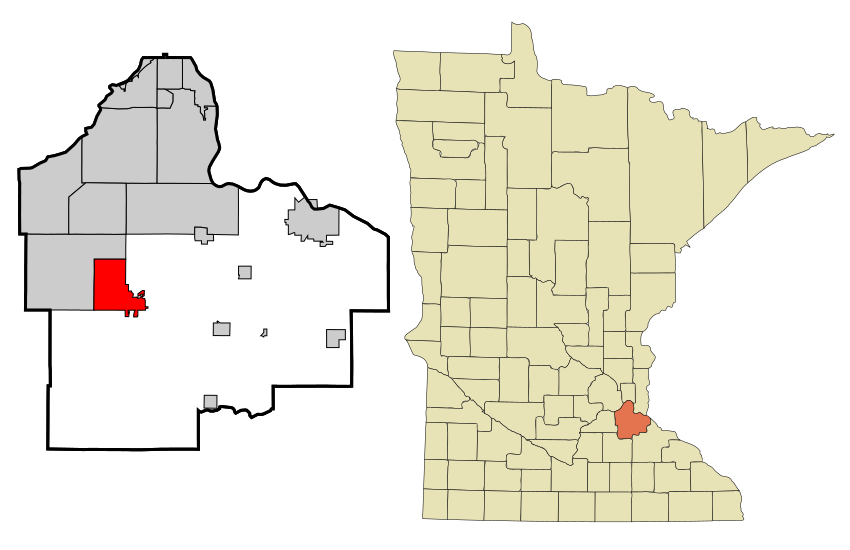
Farmington is home to 24,464 residents in Dakota County, Minnesota, a growing market up 3.4% since 2020. Local businesses here run on the same operations HummingAgent automates: answering every call, qualifying leads, scheduling, and keeping records straight.
Farmington AI Automation Use Cases
HummingAgent helps Farmington businesses identify repetitive workflows that can be improved with Private GPT, AI receptionist systems, agentic workflows, and intelligent automation built around real operations.
Serving Farmington's Diverse Business Community
From cutting-edge technology to diverse industries, Farmington businesses face unique challenges that demand innovative automation solutions.
AI Automation Services for Farmington Businesses
Comprehensive automation solutions tailored for Minnesota businesses
Customer Support Automation
24/7 AI voice agents and chatbots that handle customer inquiries, schedule appointments, and qualify leads for Farmington businesses.
Learn moreBusiness Process Automation
Streamline workflows, automate repetitive tasks, and connect your Farmington business systems for maximum efficiency.
Learn morePrivate ChatGPT
Secure, enterprise-grade AI assistants trained on your Farmington company's data. Keep sensitive information private.
Learn moreEnterprise AI Solutions
Custom AI implementations for larger Minnesota organizations with complex requirements and multiple departments.
Learn moreAI Workflow Automation
End-to-end workflow automation that connects your tools and eliminates manual processes for Farmington teams.
Learn moreAI Web Creations
AI-powered websites and landing pages that convert visitors into customers for Farmington businesses.
Learn moreIndustry-Specific AI Solutions
Specialized automation for Farmington's key industries
AI for Law Firms
Automate client intake, document review, and legal research for Farmington attorneys.
Explore legal solutionsAI for Healthcare
Secure automation for Farmington medical practices and healthcare providers.
Explore healthcare solutionsAI for Real Estate
Lead qualification, property inquiries, and showing scheduling for Farmington agents.
Explore real estate solutionsHow We Deploy AI for Farmington Businesses
A proven 4-step process that takes you from first conversation to working automation — usually in weeks, not months.
1. Discovery & Audit
We map your workflows and pinpoint the highest-ROI automation opportunities — no guesswork, no generic templates.
2. Custom Build
We build AI agents trained on your business and your data, designed around how you actually operate.
3. Integrate & Test
We connect to the tools you already use and test against real-world scenarios before anything goes live.
4. Launch & Optimize
We deploy, monitor, and continuously improve — with 24/7 support so your automation keeps getting better.
Proven Results for Businesses Like Yours
Farmington businesses want to see the work before booking a call. Here it is — real deployments, real outcomes.
Super Park
We built "Chatty," a 24/7 AI chatbot that handles customer service across 9,085 managed parking spaces.
Read the case studyJVRC
We transformed Colorado's premier legal research firm from paper subscriptions and manual PDF searching into a fully digital AI search platform.
Read the case studyK3 Technology
We gave K3 their own private ChatGPT with memory across clients and projects — using GPT, Claude, and 30+ models while keeping their data private.
Read the case studyReviews
What clients say on Google
“Humming Agent AI has been a trustworthy and reliable partner in helping our agency, GroundFloor Media, build a secure, proprietary AI environment from the ground up. Our team uses ChatGFM daily for research, data analysis, and editing, and it's made our work noticeably sharper and more efficient. It's freed us up to spend less time on the mechanics of the work and more time on strategy and creative thinking. Highly recommend them if you're looking for a team that understands both AI and how organizations actually work.”
“Humming Agent AI was a fantastic partner in developing our proprietary and secure AI tool, ChatGFM, from the ground up. They helped us to create an AI workspace wired into our own agency context and processes, not some off-the-shelf tool. They took our input seriously and shipped something that actually fits how we work. A great partner to work with that I highly recommend.”
“Amazing Team. Always very responsive and knowledgeable. My company hired them for an ongoing large project to create an AI agent for answering phones with a new calendar and CRM system. This agent has been designed with logic for our specific company with many verticals making it a tough task and everything is working great. We have calls going directly to AI and booking appointments. This has helped us greatly close more calls especially after hours and weekends when we get most of our call / email and text traffic. Would highly recommend them to anyone, very happy customer.”
Why Farmington Businesses Choose Humming Agent
Local Farmington Presence
We understand Farmington business needs. Our remote-first team scopes each implementation around your workflows, systems, and support requirements.
Planned Implementation Support
Discovery, launch planning, and support are scoped around your team's workflows, systems, and availability in Farmington.
Minnesota-Sized Value
We scope AI automation around your workflow volume, integrations, data readiness, and support model before recommending a build.
Quick Farmington Stats
Explore Farmington
A look at the business environment where teams evaluate AI automation, workflow design, and practical implementation support.
Farmington Business Automation Overview
Farmington, Minnesota sits about 30 miles south of downtown Minneapolis in Dakota County, and it has quietly become one of the fastest-growing suburbs in the Twin Cities metro.
The city's population has climbed from 23,659 at the 2020 census to roughly 25,600 today, an increase of more than 8 percent in just a few years, and the growth shows no sign of slowing.
Median household income sits at a healthy $123,673, well above both the state and national averages, and the median home price has pushed past $465,000, up nearly 20 percent year over year according to recent Redfin data.
That combination, rising incomes, rising housing costs, and a young median age of 35.4, tells you exactly who runs the businesses in Farmington: owners and operators who are busy, growing fast, and short on time.
Farmington's economy still carries the fingerprints of its agricultural roots. The city's signature summer festival, now called Top the Tater Days (formerly Dew Days, a tradition dating back to 1979), nods directly to the potato farms that once defined the area. But the local economy today looks very different.
Dakota Electric Association, a member-owned electric cooperative, is headquartered in Farmington and remains one of the city's most visible institutional employers. Farmington Area Public Schools, Independent School District 192, serves roughly 6,000 students from a district services center on Flagstaff Avenue and is one of the largest single employers in the community.
And on the logistics side, national trucking carrier R&L Carriers announced a 100,000-square-foot terminal expansion in Farmington, a strong signal that the city's location along Highway 3 and near Highway 52 makes it an attractive freight and distribution point for companies serving the entire Twin Cities metro and beyond.
The city government has leaned into this momentum, branding Farmington as "Unexpectedly Bold" through its Economic Development Authority, which actively works on business retention and expansion alongside new investment.
That's the right instinct, because Farmington's businesses, from the downtown storefronts along the city's historic core to the utility co-op headquarters to the freight terminals off Highway 3, are all wrestling with the same problem: too much manual, repetitive work and not enough staff time to grow.
This is exactly where automation earns its keep. Minnesota's statewide minimum wage rose to $11.41 an hour as of January 1, 2026, but real wages for the customer service, administrative, technical support, and sales roles that Farmington businesses actually hire for run far higher, often $19 to $30 an hour before benefits and payroll tax in the competitive Dakota County labor market.
Every hour a staff member spends manually entering data, chasing down a scheduling conflict, or answering the same billing question for the fifth time that day is an hour that isn't going toward the growth Farmington's business owners are chasing.
For a city adding residents and rooftops faster than most of its Dakota County neighbors, the businesses that automate the repetitive work now are the ones that will be positioned to serve that growing population without simply throwing more headcount at the problem.
HummingAgent works with businesses in Farmington and across the Twin Cities metro to build custom AI-powered automation and consulting engagements, not off-the-shelf chatbots, but systems designed around how a specific business actually operates.
The company's approach was recognized with the TMC 2025 AI Agent Product of the Year award, and it has already built production systems for companies including Super Park, JVRC, and K3 Technologies.
For Farmington business owners weighing whether automation makes sense for a growing Dakota County community of this size, the short answer is: the math already works, and it gets better every year housing costs and wages keep climbing the way they have here.
Industry-Specific Automation Solutions
Tailored solutions for Farmington's key business sectors
Farmington Business Districts
DOWNTOWN FARMINGTON
Farmington's historic downtown, generally understood as the area south of County Road 50, is the city's original commercial core. It's home to a mix of longstanding local shops, restaurants, and service businesses, and it's currently the focus of city redevelopment conversations, including efforts around the historic Security Bank building.
Downtown businesses here tend to be small, owner-operated, and highly reliant on foot traffic and phone-based customer inquiries, making them prime candidates for automated answering and scheduling tools that don't require pulling staff off the floor.
UPTOWN FARMINGTON
Just north of downtown, the Uptown area blends established residential streets with a growing mix of professional offices, clinics, and neighborhood retail. Businesses here, from local financial services offices to health and wellness practices, run appointment-heavy operations where a missed call or a scheduling error has an outsized impact on a small client base. Automated booking confirmations and reminder systems are a natural fit for this part of the city.
NORTH FARMINGTON
The area north of County Road 50 has seen the bulk of Farmington's residential growth over the past two decades, and with it has come a wave of new retail, home-service, and construction-adjacent businesses serving the expanding subdivisions.
Contractors, real estate offices, and service franchises operating out of North Farmington are dealing directly with the scheduling and lead-intake volume that comes from a rapidly growing customer base, making automated intake and dispatch tools especially valuable here.
NORTHEAST FARMINGTON EMPIRE TOWNSHIP CORRIDOR
Along the city's northeast edge, where Farmington borders Empire Township, newer commercial and light-industrial development has followed the residential expansion. This corridor includes logistics-adjacent businesses benefiting from proximity to Highway 3, along with service companies supporting the newer housing developments nearby. These operations tend to run leaner back-office teams, which makes automating dispatch, scheduling, and customer-status updates a high-leverage move.
VERMILLION RIVER GREENWAY CORRIDOR
The Vermillion River trail winds through Farmington, connecting the downtown, uptown, and Empire Township neighborhoods, and the small businesses that have clustered near the trailheads, cafes, fitness studios, and outdoor-recreation retailers, depend heavily on seasonal foot traffic.
These businesses see sharp swings between the trail's busy summer season and Minnesota's long winter, making flexible, low-overhead automation for booking and customer communication particularly valuable when staffing needs to flex with the weather.
Seasonal Business Patterns
Farmington's business calendar is shaped as much by Minnesota's climate as by anything else. Winters here are long and genuinely severe, ISD 192 maintains formal cold-weather event protocols for school closures, and freight, construction, and home-service businesses all have to build slower, higher-cost operating plans into December through March.
Automated weather-triggered rescheduling and customer notification systems matter enormously during this stretch, since a single ice storm can force dozens of appointment changes in a single afternoon, work that's brutal to manage by phone tree but straightforward to automate.
Spring and summer flip the pattern entirely. Residential construction and home-service companies hit their busiest stretch as Minnesota's short building season compresses a year's worth of demand into six or seven months.
Late June brings Top the Tater Days, Farmington's signature community festival (formerly known as Dew Days, running continuously since 1979), which draws heavy foot traffic to the downtown corridor and puts real strain on small retail and restaurant staffing for a concentrated weekend.
Back in late August, ISD 192's roughly 6,000-student enrollment cycle creates a predictable spike in district office call volume, one that automated FAQ and document-intake systems handle far more gracefully than a front desk answering the same registration questions for the two-hundredth time.
The throughline across every season is the same: Farmington's businesses face genuinely large, predictable swings in demand, weather-driven in winter, construction-driven in summer, festival-driven in June, enrollment-driven in August, and automation is what lets a lean local team absorb those swings without either overstaffing for the slow months or burning out during the busy ones.
ROI & Cost Analysis
Minnesota's statewide minimum wage reached $11.41 an hour on January 1, 2026, but almost no Farmington business is actually staffing customer-facing or administrative roles at that floor.
In a Dakota County labor market this competitive, with median household income above $123,000 pulling wages up across every sector, realistic fully loaded costs (base wage plus roughly 25 percent benefits and 7.65 percent payroll tax, a combined loading factor of about 32.65 percent) look more like this:
| Role | Base Wage | Fully Loaded Hourly | Fully Loaded Annual (1 FTE) | |------|-----------|---------------------|------------------------------| | Customer Service | $19/hr | ~$25.20/hr | ~$52,400 | | Administrative | $21/hr | ~$27.85/hr | ~$57,950 | | Technical Support | $29/hr | ~$38.45/hr | ~$79,980 | | Sales Support | $23/hr | ~$30.50/hr | ~$63,440 |
Scaling those fully loaded costs across a growing team shows why automation compounds quickly as a Farmington business adds headcount:
| Role | 1 Employee | 5 Employees | 10 Employees | 25 Employees | |------|-----------|-------------|---------------|----------------| | Customer Service | ~$52,400 | ~$262,000 | ~$524,000 | ~$1,310,000 | | Administrative | ~$57,950 | ~$289,750 | ~$579,500 | ~$1,448,750 | | Technical Support | ~$79,980 | ~$399,900 | ~$799,800 | ~$1,999,500 | | Sales Support | ~$63,440 | ~$317,200 | ~$634,400 | ~$1,586,000 |
If automation illustratively offsets 25 to 35 percent of the repetitive-task hours embedded in those roles, a Farmington business running a 10-person mixed customer-service and administrative team could be looking at an estimated $150,000 to $230,000 in annual labor-cost equivalent freed up, not necessarily through layoffs, but through avoiding the next 2 to 3 hires that rapid growth would otherwise force.
For a city adding population at nearly 1 percent a year with home prices climbing 19 percent in a single year, that's the difference between growing headcount linearly with demand and growing revenue faster than payroll.
Implementation Roadmap
Your strategic path to successful business automation in Farmington
Discovery & Local Fit Assessment (Weeks 1-2).
What happens in this phase:
Custom Build (Weeks 3-6).
What happens in this phase:
Integration & Compliance Check (Weeks 6-8).
What happens in this phase:
Pilot & Full Deployment (Weeks 8-12).
What happens in this phase:
Ready to transform your Farmington business?
Get a scoped estimateCompliance & Regulations
Minnesota's Consumer Data Privacy Act, which took effect in 2025, imposes obligations on businesses handling Minnesota residents' personal data, including transparency requirements and consumer rights around data access and deletion. Any Farmington business automating customer intake or communication needs systems built with those requirements in mind from the start, not bolted on afterward.
Businesses operating in regulated sectors, utilities, healthcare-adjacent services, financial services, face additional layers tied to their specific industry. The City of Farmington's business licensing and permitting processes, handled through city hall, also matter for any automation touching permit-status communication or code-compliance workflows tied to the city's rapid residential growth.
Success Metrics & KPIs
Farmington businesses adopting automation for customer service, scheduling, and administrative workflows can reasonably expect meaningful, measurable movement across a few core metrics: reduced average call-handling time, fewer missed or double-booked appointments (particularly valuable given how seasonal demand spikes stress manual scheduling here), faster response times during peak periods like storm season or Top the Tater Days weekend, and a measurable reduction in overtime and after-hours staffing costs.
Businesses in fast-growing suburbs like Farmington, where population growth of roughly 8 percent since 2020 has outpaced staffing growth at most small and mid-sized companies, tend to see the clearest gains in their ability to absorb new customer volume without a proportional new hire.
The goal isn't headcount reduction, it's making sure a growing Dakota County business doesn't have to keep adding staff at the same rate it's adding customers.
Farmington businesses adopting automation for customer service, scheduling, and administrative workflows can reasonably expect meaningful, measurable movement across a few core metrics: reduced average call-handling time, fewer missed or double-booked appointments (particularly valuable given how seasonal demand spikes stress manual scheduling here), faster response times during peak periods like storm season or Top the Tater Days weekend, and a measurable reduction in overtime and after-hours staffing costs.
Businesses in fast-growing suburbs like Farmington, where population growth of roughly 8 percent since 2020 has outpaced staffing growth at most small and mid-sized companies, tend to see the clearest gains in their ability to absorb new customer volume without a proportional new hire.
The goal isn't headcount reduction, it's making sure a growing Dakota County business doesn't have to keep adding staff at the same rate it's adding customers.
Competitive Advantage
Traditional staffing in Farmington means competing for talent against the entire Twin Cities metro labor market, where fully loaded costs for a single customer-service or administrative hire routinely exceed $50,000 to $60,000 annually once benefits and payroll tax are included, and where Dakota County's rising cost of living (driven heavily by the area's steep home-price growth) puts continued upward pressure on wages.
Generic chatbot platforms marketed to small businesses offer a cheaper entry point but typically can't handle Farmington-specific scheduling logic, seasonal call patterns, or integration with the specific tools a local utility cooperative, freight terminal, or downtown storefront already runs, leaving businesses with a tool that answers simple questions but escalates everything that actually matters.
DIY automation built in-house, meanwhile, tends to underestimate the ongoing maintenance burden: someone still has to update scripts, retrain intent recognition, and fix integration breaks every time a connected system changes, hidden costs that rarely show up in the initial build estimate but show up every month afterward.
Frequently Asked Questions
Strategic Implementation Timeline
Farmington is growing faster than most of Dakota County, and the businesses that automate the repetitive parts of their operations now, before the next wave of residents arrives, are the ones that will handle that growth without a proportional spike in payroll. Whether it's a utility cooperative managing member calls, a freight terminal coordinating dispatch along Highway 3, a contractor keeping up with North Farmington's building boom, or a downtown storefront trying to answer the phone without losing the customer standing at the counter, the math works better every year wages and housing costs climb in this market. Call HummingAgent's live demo line at 720-770-2664 to hear how a custom automation build sounds in practice, and start the conversation about what a Farmington-specific implementation could look like before the next busy season hits.
Get Your Free Farmington AI Strategy Session
Discover how AI automation can transform your Minnesota business with a personalized consultation
No credit card required • 30-minute consultation • Immediate value
Proudly Serving All Farmington Area
Complete coverage across Farmington and surrounding communities with workflow and implementation experience across remote-first service areas
Response Planning
Escalation paths and service levels scoped around your actual workflows
Remote-First Team
Discovery, implementation, and support scoped for your operating model
Trusted Partner
Scoped discovery and implementation planning for real workflows
Ready to scope AI automation opportunities for your Farmington operation?
Schedule a discovery call to scope your workflow, systems, and implementation needs. We'll help estimate the workflow-specific impact before you commit.
Got Questions?
We've Got Answers
Everything Farmington business owners need to know about transforming their operations with AI automation
Simple pilots can often start in weeks, while larger projects depend on integrations, data readiness, security review, and approval cycles. We scope timeline during discovery and prioritize the safest useful first workflow.
Still have questions? We're here to help!
Why Farmington Businesses Choose Humming Agent
As a Farmington business owner, you need automation solutions that understand your local market, regulations, and customer base. Our team combines workflow design, AI engineering, and implementation experience to scope practical automation opportunities.
In today's competitive Farmington market, businesses need every advantage they can get. Our AI automation platform provides that edge by handling routine tasks, qualifying leads, scheduling appointments, and providing instant customer support - all while you focus on growing your business.
We're not just another tech company. We understand the unique challenges facing Farmingtonbusinesses, from seasonal fluctuations to local competition. Our solutions are designed specifically to address these challenges and help you thrive in the Minnesota market.
The Farmington Advantage
Ready to Transform Your Farmington Business?
Get a free consultation to see how AI automation can work for you
AI Automation in Nearby Cities
We also provide comprehensive AI automation services in these nearby locations:
Transform Farmington Today
Free consultation available