Hurricane AI Workflow Planning Company
Transform your Hurricane, WV business with AI automation. Serving Putnam County's fastest-growing city in healthcare, retail, and manufacturing.
Hurricane at a glance
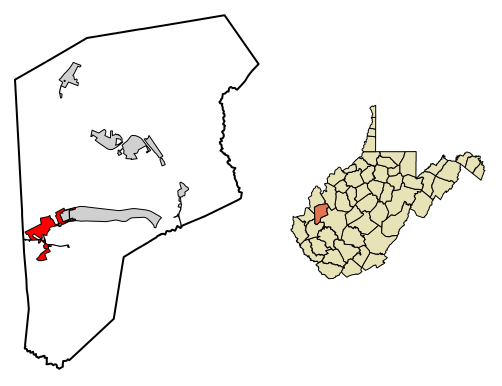
Hurricane is home to 6,813 residents in Putnam County, West Virginia, an established market of 6,953 in 2020. Local businesses here run on the same operations HummingAgent automates: answering every call, qualifying leads, scheduling, and keeping records straight.
Hurricane AI Automation Use Cases
HummingAgent helps Hurricane businesses identify repetitive workflows that can be improved with Private GPT, AI receptionist systems, agentic workflows, and intelligent automation built around real operations.
Serving Hurricane's Diverse Business Community
From cutting-edge technology to diverse industries, Hurricane businesses face unique challenges that demand innovative automation solutions.
AI Automation Services for Hurricane Businesses
Comprehensive automation solutions tailored for West Virginia businesses
Customer Support Automation
24/7 AI voice agents and chatbots that handle customer inquiries, schedule appointments, and qualify leads for Hurricane businesses.
Learn moreBusiness Process Automation
Streamline workflows, automate repetitive tasks, and connect your Hurricane business systems for maximum efficiency.
Learn morePrivate ChatGPT
Secure, enterprise-grade AI assistants trained on your Hurricane company's data. Keep sensitive information private.
Learn moreEnterprise AI Solutions
Custom AI implementations for larger West Virginia organizations with complex requirements and multiple departments.
Learn moreAI Workflow Automation
End-to-end workflow automation that connects your tools and eliminates manual processes for Hurricane teams.
Learn moreAI Web Creations
AI-powered websites and landing pages that convert visitors into customers for Hurricane businesses.
Learn moreIndustry-Specific AI Solutions
Specialized automation for Hurricane's key industries
AI for Law Firms
Automate client intake, document review, and legal research for Hurricane attorneys.
Explore legal solutionsAI for Healthcare
Secure automation for Hurricane medical practices and healthcare providers.
Explore healthcare solutionsAI for Real Estate
Lead qualification, property inquiries, and showing scheduling for Hurricane agents.
Explore real estate solutionsHow We Deploy AI for Hurricane Businesses
A proven 4-step process that takes you from first conversation to working automation — usually in weeks, not months.
1. Discovery & Audit
We map your workflows and pinpoint the highest-ROI automation opportunities — no guesswork, no generic templates.
2. Custom Build
We build AI agents trained on your business and your data, designed around how you actually operate.
3. Integrate & Test
We connect to the tools you already use and test against real-world scenarios before anything goes live.
4. Launch & Optimize
We deploy, monitor, and continuously improve — with 24/7 support so your automation keeps getting better.
Proven Results for Businesses Like Yours
Hurricane businesses want to see the work before booking a call. Here it is — real deployments, real outcomes.
Super Park
We built "Chatty," a 24/7 AI chatbot that handles customer service across 9,085 managed parking spaces.
Read the case studyJVRC
We transformed Colorado's premier legal research firm from paper subscriptions and manual PDF searching into a fully digital AI search platform.
Read the case studyK3 Technology
We gave K3 their own private ChatGPT with memory across clients and projects — using GPT, Claude, and 30+ models while keeping their data private.
Read the case studyReviews
What clients say on Google
“Humming Agent AI has been a trustworthy and reliable partner in helping our agency, GroundFloor Media, build a secure, proprietary AI environment from the ground up. Our team uses ChatGFM daily for research, data analysis, and editing, and it's made our work noticeably sharper and more efficient. It's freed us up to spend less time on the mechanics of the work and more time on strategy and creative thinking. Highly recommend them if you're looking for a team that understands both AI and how organizations actually work.”
“Humming Agent AI was a fantastic partner in developing our proprietary and secure AI tool, ChatGFM, from the ground up. They helped us to create an AI workspace wired into our own agency context and processes, not some off-the-shelf tool. They took our input seriously and shipped something that actually fits how we work. A great partner to work with that I highly recommend.”
“Amazing Team. Always very responsive and knowledgeable. My company hired them for an ongoing large project to create an AI agent for answering phones with a new calendar and CRM system. This agent has been designed with logic for our specific company with many verticals making it a tough task and everything is working great. We have calls going directly to AI and booking appointments. This has helped us greatly close more calls especially after hours and weekends when we get most of our call / email and text traffic. Would highly recommend them to anyone, very happy customer.”
Why Hurricane Businesses Choose Humming Agent
Local Hurricane Presence
We understand Hurricane business needs. Our remote-first team scopes each implementation around your workflows, systems, and support requirements.
Planned Implementation Support
Discovery, launch planning, and support are scoped around your team's workflows, systems, and availability in Hurricane.
West Virginia-Sized Value
We scope AI automation around your workflow volume, integrations, data readiness, and support model before recommending a build.
Quick Hurricane Stats
Explore Hurricane
A look at the business environment where teams evaluate AI automation, workflow design, and practical implementation support.
Hurricane Business Automation Overview
Hurricane, West Virginia stands as Putnam County's largest incorporated city and one of the fastest-growing communities in the Mountain State, with 6,959 residents and a business ecosystem that punches well above its weight.
Positioned along Interstate 64 roughly 20 miles west of Charleston and 25 miles east of Huntington, Hurricane has evolved from a small rail town — incorporated in 1888 after the 1873 arrival of the C&O Railroad — into a thriving suburban hub anchoring the Teays Valley commercial corridor, one of the most economically dynamic stretches in all of West Virginia.
The city's economy employs approximately 3,410 workers across its primary sectors. Healthcare and Social Assistance leads with 576 employees, followed closely by Educational Services (414) and Retail Trade (408), with Manufacturing and Construction rounding out the top five. Employment grew 4.51% from 2023 to 2024, a growth rate that significantly outpaces the broader West Virginia economy.
Median household income sits at $71,167, well above the statewide median, reflecting the professional workforce of dual-income families who have migrated to Hurricane for its quality schools, suburban amenities, and affordable housing relative to Northern Virginia or Northern Ohio markets.
The three pillars anchoring Hurricane's employer base tell the story of modern Putnam County.
Toyota Motor Manufacturing West Virginia in nearby Buffalo — a facility that began with 300 employees in 1998 and now employs more than 2,000 people after 12 expansions, including an ongoing $453 million investment adding 80 new jobs in transmission production — draws skilled manufacturing workers from across the region, many of whom choose Hurricane as their home base.
CAMC Teays Valley Hospital, a 70-bed acute care facility at 1400 Hospital Drive with nearly 400 nurses and clinical staff, serves as the community's healthcare anchor and a major employer in its own right.
Putnam County Schools operates Hurricane High School and multiple elementary campuses, collectively employing hundreds of educators and support staff.
Beyond these anchors, the Liberty Square Shopping Center and the broader Teays Valley retail corridor has attracted Target, Walmart Supercenter, Kohl's, HomeGoods, ALDI, and national restaurant chains, creating a retail employment base that serves not just Hurricane residents but shoppers from across the Tri-State region.
With a cost of living index of 89 (11% below the national average), a median home price of $210,500, and an unemployment rate of just 2.6%, Hurricane offers businesses an exceptionally favorable operating environment.
Bloomberg Businessweek has recognized Hurricane as the Best Place to Raise a Family in West Virginia — an accolade that signals the community stability and purchasing power that make Hurricane businesses viable.
For Hurricane's business owners navigating this fast-moving, labor-competitive market, intelligent automation represents the strategic lever that separates sustainable growth from stagnation.
West Virginia's minimum wage of $11.00 per hour — scheduled to rise to $12.00 by year's end and $15.00 by 2028 — combined with the tight 2.6% unemployment rate means every open position carries real cost and real risk. Businesses that automate routine operations now build the foundation to grow through the coming wage-pressure decade.
Industry-Specific Automation Solutions
Tailored solutions for Hurricane's key business sectors
Healthcare
Practical automation considerations for this sector
and Medical Services
Local Presence
Specific Challenges
Automation Opportunities
ROI Calculation
A four-person administrative team at a Hurricane medical practice costs approximately $192,000 annually with benefits and overhead.
Automating intake, scheduling, and billing coordination reduces staffing need by two FTEs, saving $96,000 per year against a monthly automation cost under $800.
Representative workflow example:
Professional Services
Practical automation considerations for this sector
and Real Estate
Local Presence
Specific Challenges
Automation Opportunities
ROI Calculation
A three-agent real estate team in Hurricane spending 15 hours per week on manual lead follow-up saves 780 hours annually through automation.
At an agent's opportunity cost of $85/hour, that represents $66,300 in recovered productive time for a $500/month automation investment.
Representative workflow example:
Retail
Practical automation considerations for this sector
Trade and Consumer Services
Local Presence
Specific Challenges
Automation Opportunities
ROI Calculation
A mid-size Hurricane retail operation with five hourly employees at $12.50 average wage spends roughly $156,000 annually on direct labor plus overhead.
Automating scheduling, inventory, and customer marketing reduces required labor hours by 20%, saving $31,200 annually against automation costs of approximately $600/month.
Representative workflow example:
Hurricane Business Districts
TEAYS VALLEY CORRIDOR
The Teays Valley unincorporated community adjacent to Hurricane's eastern boundary is the region's commercial and retail powerhouse. Liberty Square Shopping Center anchors a dense retail strip on Route 34 at Teays Valley Road with Target (150+ jobs), ALDI, Dollar Tree, and a collection of national fast-casual restaurants.
Walmart Supercenter, HomeGoods, Kohl's, and Big Lots operate nearby, making this the primary regional shopping destination for all of Putnam County. Population in the Teays Valley CDP alone is estimated at 3,739 residents, nearly matching Hurricane proper.
Businesses here face high-volume customer flow but intense competition from national chains; automation for local and independent operators focuses on customer loyalty, inventory precision, and operational speed that national competitors take for granted.
HURRICANE DOWNTOWN AND CENTRAL BUSINESS DISTRICT
Hurricane's historic core along Main Street and the US Route 60 commercial spine retains the B-2 Central Business District zoning that traces back to the railroad era. The downtown corridor contains locally-owned restaurants, professional offices, financial services, auto dealerships, and specialty retail catering to long-established residents.
Hurricane City Park — home to the annual Hurricane Harvest Festival every September — anchors the civic center of the downtown area. Independence Day celebrations draw the community together each July, creating brief but intense demand surges for food, beverage, and event-service businesses.
Businesses in this corridor benefit from community loyalty and identity but require smart customer communication and event-coordinated marketing automation to compete for attention with the Teays Valley retail corridor.
US ROUTE 60 HIGHWAY COMMERCIAL ZONE
Stretching east toward Scott Depot and west toward Barboursville, the Route 60 B-3 Highway Business corridor hosts auto service shops, storage facilities, logistics-adjacent businesses, national fast-food and casual dining chains, medical and dental clinics, and the service businesses that support Hurricane's commuter population.
With a mean commute time of 24.8 minutes to work — many residents driving to Charleston or Huntington daily — this corridor caters to working families who value speed and convenience. Businesses along Route 60 compete on accessibility; automation for businesses here centers on online booking, fast response to web inquiries, and frictionless customer communication.
WINFIELD HURRICANE INDUSTRIAL CORRIDOR
North of I-64 between Hurricane and the county seat at Winfield, light industrial and flex-commercial properties house manufacturing suppliers, wholesale distributors, construction material suppliers, and service contractors supporting both the Toyota supply chain and the residential construction market.
Putnam County's 1,784 private-sector establishments are spread across this corridor and adjacent areas. Businesses in this zone often interact directly with Toyota's supplier qualification system, creating urgent demand for quality documentation automation, production tracking, and digital compliance management.
SCOTT DEPOT AND OUTLYING RESIDENTIAL COMMUNITIES
East of Hurricane along the I-64 corridor, Scott Depot and surrounding subdivisions feed the Hurricane-area economy with upper-middle-income households. Median incomes in the broader Teays Valley area reach $89,045 — substantially above the Hurricane city figure — reflecting the affluent professional families who commute to Charleston but shop, dine, and obtain services in Hurricane.
Professional services, premium home services, specialty food businesses, and fitness and wellness providers serving this demographic require sophisticated CRM automation, appointment management, and personalized client communication to match client expectations.
Seasonal Business Patterns
Hurricane's position in the Kanawha Valley creates a four-season operating environment that small business owners must plan around deliberately. West Virginia winters along the I-64 corridor bring ice and occasional snow that disrupts foot traffic and construction schedules from December through February.
Heating service demand spikes sharply, and restaurants and retail experience reduced walk-in traffic during winter precipitation events.
Automation helps businesses in this period by maintaining customer communication during slowdowns, triggering service reminder campaigns for HVAC maintenance and weatherization, and optimizing staffing levels to avoid overscheduling during unpredictable weather windows.
Spring (March through May) is Hurricane's re-engagement season. The Putnam County Farmers Market reopens each Saturday from May through October at Area 34, drawing community foot traffic and creating opportunities for local food businesses and artisan retailers. Residential construction accelerates as contractors work through the backlog of projects deferred during winter.
Automation enables businesses to launch spring marketing campaigns, re-engage dormant customers with targeted offers, and scale scheduling systems ahead of the busy season without adding permanent staff.
Summer brings the Putnam County Fair in Eleanor (typically July, running two sessions over roughly ten days), the Hurricane Independence Day Celebration on the Fourth of July, and Food Truck Fridays at Hurricane City Park. These events concentrate consumer spending and create predictable demand surges.
Retail, food service, and entertainment businesses benefit from automated inventory triggers and staffing alerts tied to event proximity. The Toyota plant operates through summer shifts maintaining production schedules, keeping manufacturing-adjacent businesses active.
Fall is Hurricane's most commercially vibrant season. The Hurricane Harvest Festival in September, the return of the Putnam County Farmers Market crowd through October, and the back-to-school economic pulse from Putnam County Schools combine to create sustained consumer spending momentum. The Hurricane Fire Department Carnival and autumn community events extend the season into late October.
Businesses that automate their customer re-engagement and event-marketing workflows capture this spending wave efficiently. Contractors rush to complete exterior projects before winter sets in, creating peak demand for scheduling automation in home services.
Automation across all seasons allows Hurricane businesses to operate at higher throughput without proportional headcount increases — critical in a labor market where Toyota's $20+ hourly manufacturing wages set a high floor for any employer competing for workers.
ROI & Cost Analysis
### Labor Cost Baseline (West Virginia Minimum Wage: $11.00/hour, rising to $12.00 by end of 2025)
Customer Service Representative:
Administrative Coordinator:
Technical or Field Support Specialist:
Inside Sales / Lead Qualification:
Implementation Roadmap
Your strategic path to successful business automation in Hurricane
Business Assessment and Quick-Win Deployment (Weeks 1-4)
What happens in this phase:
Core System Integration (Months 2-3)
What happens in this phase:
Optimization and Scale (Months 4-6)
What happens in this phase:
Ready to transform your Hurricane business?
Get a scoped estimateCompliance & Regulations
### West Virginia State Business Requirements
Hurricane businesses must maintain West Virginia business registration, adhere to the state's progressive minimum wage schedule ($11.00 in 2025, $12.00 by year-end 2025, progressing to $15.00 by 2028), and comply with the West Virginia Consumer Credit and Protection Act for businesses engaging in digital marketing, lead generation, or consumer financing. Automated communications must comply with federal CAN-SPAM and TCPA requirements for email and SMS messaging, respectively.
Success Metrics & KPIs
### Customer Acquisition and Conversion
Hurricane businesses implementing HummingAgent automation typically see inbound lead-to-customer conversion rates improve by 40 to 60% within the first 90 days, driven primarily by dramatically reduced response times. Web leads in Hurricane's competitive services market have a half-life measured in minutes — automated immediate response captures prospects before they move to the next search result.
Competitive Advantage
### Traditional Staffing Costs in Hurricane's Labor Market
With Toyota Motor Manufacturing setting a de facto wage floor near $20 to $22 per hour for production workers in Putnam County, Hurricane employers in retail, services, and administration face structural upward pressure on wages that makes headcount-intensive growth models increasingly unviable.
A Hurricane business that hired a customer service coordinator at $14/hour two years ago now faces turnover to Toyota or Amazon logistics at $18-20/hour — and replacing that person requires recruiting, onboarding, and training investment that drains management time and operational continuity.
Frequently Asked Questions
Strategic Implementation Timeline
Hurricane, West Virginia is at a genuine economic inflection point. Toyota's $453 million expansion, CAMC Teays Valley's continued growth, and the Teays Valley corridor's emergence as a true regional retail and service hub are creating business opportunities that did not exist five years ago. But they are also creating competition — for customers, for talented employees, and for the first-mover advantage that automation delivers. West Virginia's minimum wage is legally mandated to reach $15.00 per hour by 2028, making today's labor costs a temporary floor, not a ceiling. Hurricane businesses that automate their customer acquisition, service delivery, and administrative operations in June 2026 position themselves to absorb that cost pressure while competitors scramble. The businesses that will lead Putnam County's next decade of growth are the ones acting now. Schedule your free Hurricane business automation assessment at hummingagent.ai today.
---
*Humming Agent serves Hurricane, Teays Valley, Scott Depot, Winfield, Eleanor, and all of Putnam County. Transform your West Virginia business with intelligent automation built for the actual scale and context of Mountain State business operations.*
Get Your Free Hurricane AI Strategy Session
Discover how AI automation can transform your West Virginia business with a personalized consultation
No credit card required • 30-minute consultation • Immediate value
Proudly Serving All Hurricane Area
Complete coverage across Hurricane and surrounding communities with workflow and implementation experience across remote-first service areas
Response Planning
Escalation paths and service levels scoped around your actual workflows
Remote-First Team
Discovery, implementation, and support scoped for your operating model
Trusted Partner
Scoped discovery and implementation planning for real workflows
Ready to scope AI automation opportunities for your Hurricane operation?
Schedule a discovery call to scope your workflow, systems, and implementation needs. We'll help estimate the workflow-specific impact before you commit.
Got Questions?
We've Got Answers
Everything Hurricane business owners need to know about transforming their operations with AI automation
Simple pilots can often start in weeks, while larger projects depend on integrations, data readiness, security review, and approval cycles. We scope timeline during discovery and prioritize the safest useful first workflow.
Still have questions? We're here to help!
Why Hurricane Businesses Choose Humming Agent
As a Hurricane business owner, you need automation solutions that understand your local market, regulations, and customer base. Our team combines workflow design, AI engineering, and implementation experience to scope practical automation opportunities.
In today's competitive Hurricane market, businesses need every advantage they can get. Our AI automation platform provides that edge by handling routine tasks, qualifying leads, scheduling appointments, and providing instant customer support - all while you focus on growing your business.
We're not just another tech company. We understand the unique challenges facing Hurricanebusinesses, from seasonal fluctuations to local competition. Our solutions are designed specifically to address these challenges and help you thrive in the West Virginia market.
The Hurricane Advantage
Ready to Transform Your Hurricane Business?
Get a free consultation to see how AI automation can work for you
AI Automation in Nearby Cities
We also provide comprehensive AI automation services in these nearby locations:
Transform Hurricane Today
Free consultation available